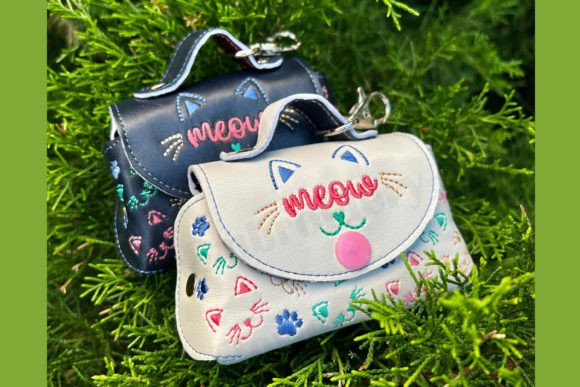
ITH Mini Bag I Love Cat Embroidery
A Designer’s First Look: Playful, Compact, and Purpose-Built
When I opened the ITH Mini Bag I Love Cat Embroidery file, my first thought wasn’t “cute”—it was “functional.” This isn’t just another cat-themed graphic slapped onto a generic bag shape. It’s an in-the-hoop (ITH) embroidery design built for real-world utility: chapstick holder, poo bag carrier, tissue pouch—small, structured, and stitch-optimized for a 7 x 10 inch hoop. The “I Love Cat” motif sits cleanly inside the bag’s front panel, balanced with gentle curves and modest lettering. No over-the-top flourishes. No fragile tendrils or micro-details that vanish under satin stitch. As a designer who’s stitched hundreds of commercial ITH projects, I appreciate how this layout respects fabric behavior—no distortion on seams, no crowding near fold lines, and enough breathing room around the cat icon to let stabilizer do its job.
Where It Shines: Real Projects, Real Customers
I tested ITH Mini Bag I Love Cat Embroidery on two parallel tracks: a batch of custom embroidered tote bags for a local pet boutique, and a set of personalized baby gifts for a new cat-loving parent. On the totes, it worked beautifully as a branded accessory—stitched onto canvas straps, then attached with clean topstitching. Customers responded immediately to the charm and clarity; one even asked if we’d make matching keychains (a natural upsell). For the baby items, I scaled it down slightly (within safe limits for the 7x10 hoop) and stitched it onto organic cotton muslin pouches holding tiny socks and burp cloths. The result felt handmade—not mass-produced—and reinforced trust: parents could see the care in the stitch density, the evenness of the satin borders, and the thoughtful placement that avoided seam stress points.
This design fits naturally into craft business workflows. As an Etsy seller, you’ll find it ideal for small-batch merchandise—think holiday gift sets, boutique aprons with coordinating mini-bag accessories, or embroidered tea towels where the bag becomes a playful focal point. It also translates well to digital product previews: drop it into a printable mockup on a neutral background, and it reads instantly as both functional and emotionally resonant. That duality—utility + warmth—is rare in Graphics-category files, and it elevates your Sewing Patterns listings beyond decoration into lifestyle storytelling.
Where to Pause—and Why
Don’t rush this into every project. ITH Mini Bag I Love Cat Embroidery performs best on stable, medium-weight fabrics like cotton twill, linen-cotton blends, or midweight denim. I tried it on a stretchy French terry sweatshirt cuff—and while it held up structurally, the slight pull distorted the cat’s ear outline. On dark fabrics, test thread contrast carefully: light gray or cream fill stitches can mute the “I Love Cat” text unless you boost density or switch to brighter thread. And avoid placing it directly over curved surfaces like cap fronts or rounded pillow corners—the bag’s flat, rectangular base needs a stable foundation to maintain crisp edges.
The design’s strength is also its limit: it’s not meant for oversized applications. Don’t scale it up for a full tote front—it wasn’t digitized for that. Likewise, skip ultra-thin silks or loosely woven gauzes unless you reinforce heavily with tear-away + cut-away stabilizer. Tiny lettering in the phrase holds up well at native size, but shrinking further risks fill-stitch dropout. If you’re making embroidered patches for resale, confirm the design’s licensing allows finished-product sales—some machine embroidery design licenses restrict commercial use without upgrade.
Designer Notes You’ll Actually Use
- Always stitch a test on scrap fabric—especially when pairing with textured materials like burlap or quilted cotton.
- Check thread color contrast on both light and dark backgrounds before stitching your final run.
- Review stitch density in your embroidery software: dense fills are great for durability but increase wear on needles and fabric.
- Confirm hoop size compatibility: this design is built for 7 x 10 inch hoops—don’t force it into smaller frames without verifying stability.
- Inspect small details in the cat’s face and lettering at 200% zoom—look for stray running stitches or under-digitized corners.
- Test black-and-white mockups to gauge visual weight and readability at retail distance.
- Use appropriate stabilizer: medium-cutaway for knits, tear-away + light cut-away for wovens, and always float the top layer for clean satin stitch.
- Verify dual-use suitability: does it work equally well for personal gifts *and* client-driven commercial embroidery? This one does—but always double-check.
Final Thought: Charm With Craftsmanship
What makes ITH Mini Bag I Love Cat Embroidery stand out isn’t novelty—it’s intentionality. It doesn’t shout. It invites. A customer sees it on a handmade tote and thinks, “That’s mine,” not “That’s cute.” That quiet resonance matters—especially for small shop owners building brand consistency through tactile, thoughtful details. It supports professionalism without sacrificing personality, adds giftability without overcomplicating assembly, and delivers recognition at a glance. In a market flooded with generic cat graphics, this design earns its place by solving a problem (where to hold the essentials) while honoring the craft behind every stitch. Whether you’re prepping for craft fair inventory, building an Etsy collection, or designing a custom apparel line, treat it like a trusted tool—not just another digital embroidery file. Test it, refine it, and let it earn its keep in real projects, real hands, and real smiles.