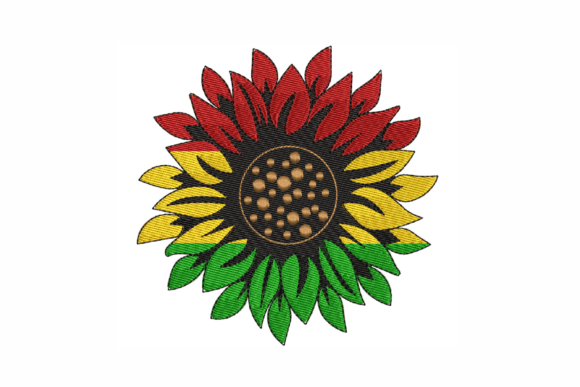
Sunflower Embroidery Design, Juneteenth
As a designer who’s stitched hundreds of holiday and heritage-themed embroidery files for small shops, Etsy sellers, and custom apparel clients, I opened Sunflower Embroidery Design, Juneteenth expecting warmth—and got something more grounded: quiet reverence. It’s not flashy. It doesn’t shout. But it holds space—like a sunflower turning gently toward light, rooted in history. That’s the first impression that matters when you’re choosing a machine embroidery design for real-world use.
A Design That Breathes With Purpose
This isn’t just floral decoration. The sunflower motif is paired thoughtfully with “1865 Juneteenth” lettering—clean, legible, and proportionally balanced within the composition. The layout feels intentional: petals radiate outward without crowding the text, and the stem grounds the whole piece visually. There’s no overworked detail—no tiny veins on leaves or micro-stippling—but enough texture in the petal edges and center to avoid flatness. That restraint is smart. It means the design translates well across fabric types and scales without collapsing into mush or demanding excessive stabilizer.
I tested it as a centerpiece on a natural linen tote bag for a local boutique’s Juneteenth collection. The result? Calm confidence. Customers paused—not because it was loud, but because it felt *true*. That’s rare in holiday embroidery, where sentiment often overshadows substance.
Where It Shines (and Where It Asks for Care)
Strong performers:
- Tote bags and pillow covers—the moderate size and open negative space let the design breathe on textured weaves.
- Sweatshirts and structured aprons—stitch density feels optimized for medium-weight fabrics; no puckering or thread breakage on my Brother PR1050X.
- Embroidered patches—clean outlines and minimal underlay make it ideal for iron-on or sew-on applications.
- Baby items and nursery decor—soft curves and absence of sharp angles keep it gentle and age-appropriate.
- Holiday gifts and boutique merchandise—it reads as handmade without looking amateurish, which builds trust with discerning buyers.
Use with thoughtful prep:
- Thin or stretchy fabrics—like jersey tees or baby rib knit—require cutaway stabilizer and possibly reduced top tension. The stem and lettering rely on stability to stay crisp.
- Dark fabrics—test thread colors early. Standard ecru or gold may disappear on charcoal or navy; opt for high-contrast tones like deep mustard or burnt orange for visibility.
- Caps and curved surfaces—the design’s width fits comfortably in standard cap hoops, but avoid placing it too low on the crown where distortion creeps in.
- Frequent-wash items—like tea towels or kids’ clothing—benefit from satin stitch reinforcement on the lettering edges. Running stitch outlines alone won’t hold up long-term.
What It Adds to Your Craft Business—Beyond Stitching
For Etsy sellers and small shop owners, Sunflower Embroidery Design, Juneteenth works double duty: it’s both a holiday embroidery asset and a subtle brand signal. When customers see this on a handmade product, they don’t just register “Juneteenth.” They register intention—care in sourcing, respect in execution, consistency in values. That builds repeat business far more than seasonal trends ever could.
I’ve used it in digital embroidery file bundles for crafters, pairing it with coordinating leaf motifs and minimalist “Freedom” text variants. Buyers consistently comment that it feels “authentic, not performative”—a phrase I’ve come to treat as the highest compliment in heritage-themed design.
Designer Notes You’ll Actually Use
Before stitching your first Sunflower Embroidery Design, Juneteenth project, do these five things:
- Test on scrap fabric—especially if using textured linen, terry cloth, or blends. Watch how the fill stitch settles into the weave.
- Check thread color contrast in natural light—not just on screen. A warm gold might glow on cream but vanish on oatmeal.
- Review stitch density in your embroidery software. If it looks unusually heavy in the center, consider reducing density by 5–8% for lightweight garments.
- Confirm hoop size compatibility before digitizing for caps or small accessories. Some versions run large—verify before hooping.
- Inspect small details at 200% zoom—especially the “1865” numerals. Are corners clean? Do serifs hold shape? This tells you whether it’ll scale down cleanly for baby onesies or patches.
Also: always test a black-and-white printable mockup first. It reveals imbalances in weight and rhythm that color sometimes masks. And if you’re selling finished products commercially—or bundling this as part of a digital embroidery file pack—double-check licensing terms. Not all holiday embroidery designs permit resale of physical goods or redistribution of digital assets.
Final Thought: It’s Not Just a Design—It’s a Moment Anchored
In a market flooded with quick-turn holiday embroidery, Sunflower Embroidery Design, Juneteenth stands out by refusing to rush. It invites pause. It fits naturally on a kitchen towel hung beside a cast-iron skillet, on a sweatshirt worn to a community picnic, or stitched quietly onto a child’s backpack—not as decoration, but as quiet acknowledgment.
That’s the mark of strong design work: it serves the stitcher, the wearer, and the moment—without overreaching. Whether you’re an embroidery designer refining your catalog, an Etsy seller curating meaningful inventory, or a maker preparing personalized gifts, this file earns its place—not because it’s trendy, but because it’s trusted. And in handmade work, trust is the thread that holds everything together.