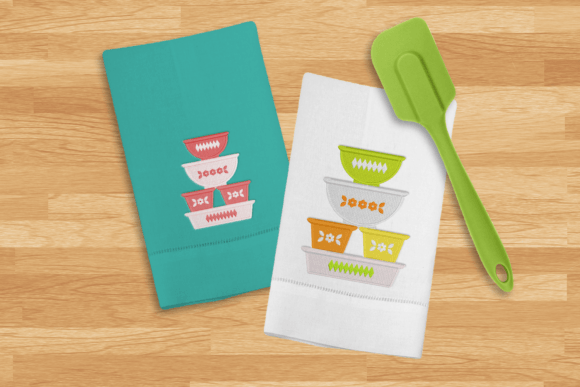
Vintage Glass Bakeware Stack Embroidery
A Design That Nods to Nostalgia—Without Sacrificing Brand Clarity
As an embroidery designer who’s digitized over 2,000 commercial files for small businesses—from neighborhood bakeries to indie florists—I opened Vintage Glass Bakeware Stack Embroidery expecting charm. What I found was something sharper: a cohesive, era-rooted visual language that feels both warmly familiar and commercially viable. The description—“bowls, casserole dishes, and loaf pans with floral and diamond motifs”—immediately signals intentionality. This isn’t just retro styling; it’s curated vintage. It reads as handmade but precise, playful but polished—ideal for brands that want approachability without leaning into kitsch.
Where This Design Earns Its Place in Real Business Use
Vintage Glass Bakeware Stack Embroidery shines where many kitchen-themed designs falter: it balances detail with scalability. As an embroidered patch on a canvas tote bag? It holds up beautifully—each dish retains definition without bleeding. On staff aprons for a boutique café or local bakery? The stacked composition creates vertical rhythm that flatters the garment’s drape and draws the eye naturally upward. For cap embroidery, the topmost bowl or floral motif anchors cleanly at the front crown, especially when simplified to two–three key elements.
It also works subtly in high-trust contexts: stitched discreetly on the hem of a linen tea towel, heat-pressed onto reusable product packaging labels, or scaled down as a sleeve accent on custom apparel for a handmade ceramics studio. Because the design leans into mid-century glassware—not generic “kitchen” clichés—it reinforces authenticity. Customers don’t just see “food”; they register craft, care, and time-honored utility. That nuance elevates perceived product value and supports brand identity rooted in heritage, not trend-chasing.
Smart Placement—and Where to Proceed With Caution
This is not a one-size-fits-all machine embroidery design. Its strength lies in medium-to-large applications (2.5"–4" wide), especially on stable, tightly woven fabrics like twill, denim, or medium-weight cotton duck. For small patch sizes under 1.75", test carefully: floral motifs and fine diamond outlines may lose legibility or require strategic simplification. On curved surfaces—like cap fronts or rounded tote handles—ensure your digitizer has built in gentle underlay and reduced stitch density to prevent puckering.
Avoid placing Vintage Glass Bakeware Stack Embroidery directly over textured fabric (e.g., heavy bouclé, corduroy) without aggressive stabilizer support. Likewise, dark uniforms demand high-contrast thread colors—navy thread on black fabric will vanish; ivory or antique white pops with warmth and clarity. And because vintage glass implies transparency and light, overly dense stitching can mute its airy charm. If your production workflow prioritizes speed over fidelity, confirm the file’s stitch density aligns with your business volume—high-density versions may slow turnaround without improving recognition.
How It Strengthens Your Small Business Merch Strategy
For Etsy sellers, handmade brands, and local studios, consistency is currency. Vintage Glass Bakeware Stack Embroidery functions as a versatile anchor across touchpoints: a chest logo on staff tees, a subtle back-neck detail on branded caps, or a repeat motif along the seam of a market tote. Unlike photorealistic or text-heavy designs, it scales gracefully into printable mockups—making client approvals faster and reducing revision cycles.
More importantly, it signals intention behind your brand identity. A pet brand using this design on bandana tags or treat-bag accents adds unexpected wit and warmth. A florist pairing it with pressed-flower packaging tells a layered story: domestic beauty, seasonal care, quiet ritual. That kind of resonance builds customer trust—not through loud messaging, but through visual coherence and emotional resonance.
Practical Designer Notes Before You Stitch
- Always test in black and white first—it reveals contrast issues and silhouette clarity before thread selection.
- Check minimum viable size: embroider a 1.5" version on your target fabric to verify motif integrity.
- Review thread color pairings against your brand palette—floral elements should harmonize, not compete.
- Inspect spacing between stacked items; tight gaps risk thread bridging on low-stabilization runs.
- Confirm hoop size compatibility—some versions may require larger hoops for full-stack rendering.
- Test on real fabric with your standard stabilizer stack, especially if using performance blends or recycled textiles.
- Create a client-facing printable mockup before finalizing—this avoids misaligned expectations on scale and placement.
- Compare alongside existing design assets: does it complement your logo, typography, and other embroidery files—or clash tonally?
- Verify commercial licensing before applying to merchandise for resale. Not all digital embroidery files include blanket commercial use rights.
Final Thought: A Kitchen-Themed Design That Transcends the Category
Many embroidery files labeled “Kitchen” default to literal, cluttered, or overly decorative treatments. Vintage Glass Bakeware Stack Embroidery avoids that trap. Its structure—layered, balanced, motif-rich yet restrained—makes it equally at home on a chef’s apron, a boutique’s gift tag, or a craft distillery’s event tote. It doesn’t scream “kitchen.” It whispers “carefully made,” “thoughtfully chosen,” and “proudly small-scale.” That subtlety is what converts casual browsers into loyal customers—and what keeps embroidery shops recommending it season after season.